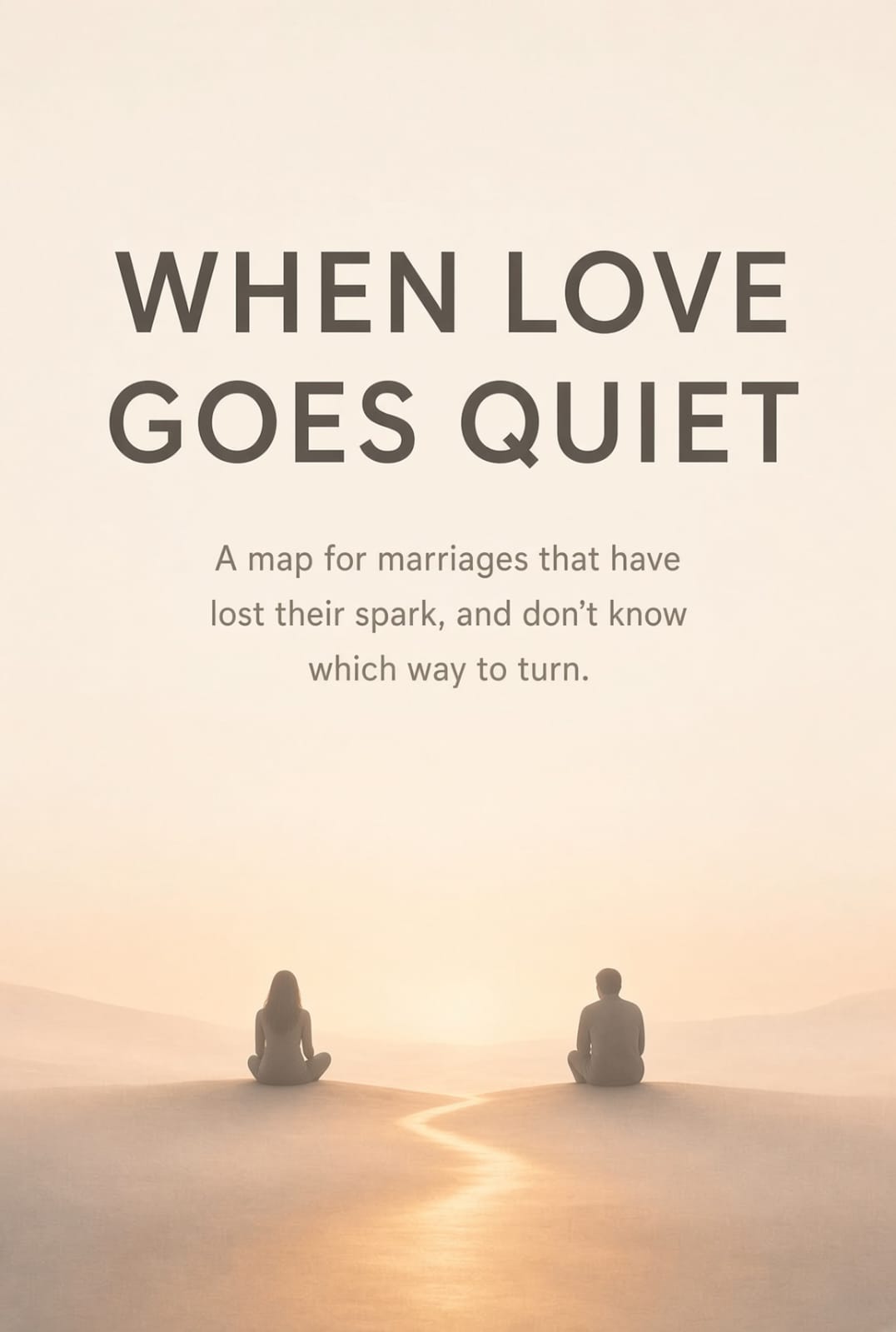
When Love Goes Quiet
A map for marriages that have lost their spark, and don’t know which way to turn.
Coming · on Amazon
A map for marriages that have lost their spark, and don’t know which way to turn.
Coming · on AmazonWho it’s for
The house runs. That’s the strange part.
You still talk — about the car, the bins, whether anyone fed the dog. It’s the other kind of talking that went.
You leave the house and nobody looks up. You come back and nobody’s face changes.
And you can’t complain about any of it, because what would you say? We get along fine and it’s slowly killing me?
If you recognised yourself somewhere in that, this book was written for you. Not for the marriage with the shouting in it, or the betrayal — those have their own books. This one is for the marriage where nothing is wrong and something is dying, and there has never been a word for it.
The opening pages
I don’t know whether you’re unhappy.
You might be. You might be able to say it plainly — I am unhappy, I have been for a while. Or you might tell me, honestly, that things are fine, that you’ve no real complaints, that plenty of people have it far worse and you’re not about to whine about a good life. Both of those are true in houses like yours.
But I’d guess at this much. You’re not joyful. Not lit up. Whatever this is, it isn’t the thing you’d have described, twenty years ago, if someone had asked what you were walking toward.
And something is up. You may not have named it yet — it might still be moving around under the surface, showing itself only in odd moments before you’re on to the next thing. But something is up, and we both know it, because you are holding this book. People with nothing wrong don’t pick this up.
So let me tell you what I think it’s like, and you can tell me where I’ve got it wrong.
The house runs. That’s the strange part. Bills paid, kids fed, calendar shared, the two of you a functioning operation. You still talk — about the car, the bins, whether anyone fed the dog, what time you’ll be back. The logistics never faltered. It’s the other kind of talking that went: the late, aimless, two-hour kind that went nowhere and mattered. You couldn’t say when it stopped. There was no last conversation that announced itself as the last one.
And in the evenings you sit in the same room, each with your own screen, and there’s a distance in it you could measure with your hands.
· · ·
Here’s what I suspect nobody knows about you: you can’t complain about any of this. Not really. The moment you try, it comes out sounding like nothing. I’m lonely. Lonely? They’re right there. They’re a good person. They’ve done nothing wrong — no drinking, no affair, no cruelty. You’ve watched friends describe real trouble, the shouting kind, the betrayal kind, and you’ve kept quiet, because what would you say? We get along fine and it’s slowly killing me? So you said nothing, year on year. And the not-saying got added to the loneliness, and now it’s part of it too.
And under that sits the question you don’t let finish. Is this just what it is now? Is this the long, well-mannered rest of it — is this what people mean when they say marriage is hard work: that you get used to this, stop expecting, and call that being grown up.
I’m not going to answer that yet. I only want you to know that I know where you are.
From the opening of When Love Goes Quiet
What it will and won’t do
It won’t promise your marriage back.
I don’t know your marriage, and anyone who promises you an outcome from behind a cover is selling you something. It won’t tell you which door is yours — whether to stay and rediscover, or to end it well — because that isn’t mine to tell you.
There are no formulas here. There’s no villain, and no chapter where it turns out to be your fault, or theirs. What there is, is a path — and it leads somewhere you may not have considered, because it doesn’t start with them. It starts with you.
You are not choosing between a good ending and a failure. Whatever this turns out to be, there is a version of it where you come out more yourself than you went in.
What’s inside
Why a marriage goes still without anybody doing anything wrong — and why the dead patch is so often the thing trying to change.
What you worked out about love as a child, watching. Not blame. Just the old answer you’re still using.
The empty stretch between letting go of the old thing and the new one arriving. What it asks: what wants to die here, and what wants to come alive?
The heart of it. Reading your own signal before it drives you. Feeling the hook in your own reaching. Meeting a trigger instead of firing it. Staying in the room. Saying the true thing from beside them, not across from them.
The ordinary Tuesday. How to live in the quiet once it’s yours — and how to put the notebook down.
When it is, it’ll be on Amazon. Leave your name and I’ll tell you the day it opens — nothing else will come, and never to sell you anything.